Posted: August 16, 2018

Good news for those holding seafarer’s medicals. These can now be used when undertaking OPITO BOSIET/HUET/FOET with CA-EBS.
An additional HSE exemption has been granted to enable those workers who hold an ENG1 medical certificate of fitness to undertake the same in-water offshore survival training as those holding an Oil and Gas UK certificate of medical fitness for offshore work
This means that delegates will be required to produce one of the three certificates outlined below:-
- Produce a valid, unexpired Oil and Gas UK (OGUK) offshore medical certificate confirming the delegate’s fitness for offshore work.
OR
- A valid, unexpired, medical certificate of fitness to work at sea.
OR
- A valid, unexpired offshore medical certificate issued by a body outside of the UK which is recognised as equivalent to the OGUK medical certificate of fitness for offshore work.
In addition to the above the delegate will be required to produce:-
A certificate of fitness to undertake shallow water CA-EBS training issued by a registered OGUK examining doctor.
OR
In the case of a Seafarers Medical with restrictions, produce a statement from an appropriate registered practitioner that the restriction or condition does not result from a respiratory or ENT condition and there is no absolute contraindication to the shallow water delegate’s participation in the training.
AND
On the date on which the delegate is to undertake shallow water CA-EBS training, and prior to entering the water in which the training takes place, the delegate gives to the OPITO-approved Centre a statement, that to the best of the delegate’s knowledge and belief, the delegate has no (current or past) medical condition which makes the delegate unfit to participate in the training.
For any queries please contact Gillian or Chloe on + 353 21 4335609

Sign Up to our Newsletter
Click Here
Posted: March 18, 2015
As with most of our blog posts lately we like to start with a quote. Just a little something to keep in mind while reading our blogs. So we have decided that for this blog our quote should be “Safety isn’t just a slogan, it’s a way of life”. Those few words explain just how our instructors work. Safety for our instructors is not just a slogan; it really is a way of life.
Who am I?
Before anybody goes offshore there are a number of courses which they must complete, depending on their role in the oil & gas sector, with a MIST, BOSIET and HUET being the basic requirement.
Seen as I’m the new marketing executive for NMCI Services I decided it was time for me to take the plunge and complete one of the many offshore courses we offer through S.N.O (SEFtec NMCI Offshore). When people read blogs they want to read about peoples personal experiences and know what exactly happens when a delegate arrives to do a course. So on Thursday March 12th I had the opportunity to be a delegate on a HUET Course.
My day as a delegate
As I’m an employee things were a little different. I didn’t have to arrive in reception at 8.45 am or I didn’t have to find my way or travel from a neighbouring country. So I was going doing the meet and greet at 1:30pm.
After the theoretical aspects of the course were completed it was time to get into the water. Before a delegate can get into the water you have to don your swimwear and a tracksuit and t-shirt. The instructor will then give you a pair of overalls and a transit suit. I have to admit this is a bit strange because you feel like you’re in a blow up boiler suit. Once the shoes are on then it’s time to put on your life jacket.
What happened…
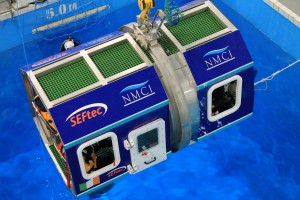
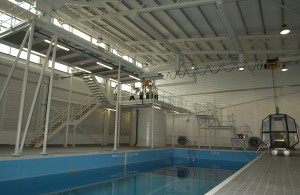
After a safety briefing pool side it was time to get into the water in our environmental pool. The temperature is kept at 21 degrees so it wasn’t cold like I had expected. It was hard to stay up in the water as at no point in our pool can you stand up. This is to help simulate the idea of being in the ocean. When you’re in the suit you have to swim backwards to stay afloat and then make your way over to the unit. Out unit is manufactured by SEFtec.
Once in the unit the instructor once again goes through what is going to happen. You are so well briefed that the idea of being underwater without air doesn’t seem so terrifying. There were 2 divers and then 2 instructors pool side. Safety is paramount when it comes to any course but for somebody who wouldn’t exactly be a water baby I definitely felt safe in the hands of all the instructors.
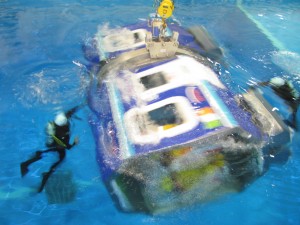
I will admit I was a bit nervous once the 3 safety checks had been done and the briefing had been completed. Before completing the first exercise we once again completed the 3 safety checks and went into the brace position. Once the unit hit the water it was time to pull the emergency strap on the window and once the water reached chest level it was time to take that big breath of air. Depending on which side of the ditcher unit you are in you have one hand on the window and the other on your buckle. This helps ensure that you are in a position to release the buckle and to push the window out so you can easily remove yourself from the unit. The first time the unit was submerged I found I was able to hold my breath but then again I did probably get out too fast. Second time around I was more psyched up to do it and the instructors helped calm me and motivate me to complete the training. Safety checks were completed again, brace position, pull the latch, take a deep breath and then once the unit has stopped moving unbuckle and remove yourself through the window. I didn’t seem to follow the steps and when I went to unbuckle I didn’t fully twist the buckle to unlock it. This meant I was stuck. Like I previously mentioned I’m not exactly a water baby so my immediate response was to panic. The instructors and divers are on high alert and noticed straight away and released me from behind my seat. Once I reached the surface I was perfect but I had gotten a bit of a shock. Third time lucky right? Well that did work. On my third attempt I completed each of the steps. This time I even decided to stay in the unit just a while longer as I wasn’t sure if it had stopped moving. Then once I did get out I was ready to take on the “capsize” aspect of the training.
The adrenaline was obviously present at this stage because I was a nervous wreck the night before thinking about it and then I was all go. I returned to the unit and once again strapped in and completed the safety briefing then the safety checks. I was fortunate enough to do the capsize without the window in the unit, don’t know if I would even have the strength to push out the window. The unit was being submerged in the water, I placed my right hand on the window frame tightly and placed my left hand on my buckle. Once we were completely submerged and the unit began to capsize the force of water wasn’t what I was expected and I lost my grip on the windows edge which did frighten me. I had my eyes open which meant I could see everything moving really fast. I would definitely recommend delegates to keep their eyes closed if possible as it’s hard to adapt to the change in surroundings when you’re capsizing.
Overall experience
The instructors and divers really made me feel comfortable in the water. It’s not an easy task completing any training but knowing you have people, for whom safety is a way of life, by your side definitely helps you relax. From the moment I walked up the stairs to the pool to the moment I got out of the environmental pool I felt like I was in safe hands. Everything is explained numerous times and they ask questions to ensure you are comfortable. For me, even climbing up a ladder is terrifying, so knowing that I was able to complete a HUET, I can safely say it was down to the team of people who were there on the day. For some delegates it can be extremely challenging to complete courses and I can now understand the nerves they develop, but I was the same and the team here at SEFtec NMCI Offshore helped me to face my fears. If I can do it then you can too…
Thanks for an amazing afternoon Joey, Terry, Cillian & Melissa.
Sign Up to our Newsletter
Click Here
Posted: March 21, 2013
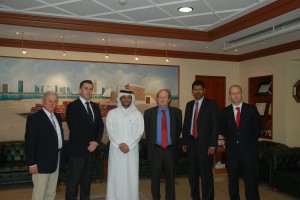 On 14 March 2013, His Excellency Sheikh Saoud bin Abdulrahman Al-Thani, Minister of Sport & Secretary General of the Qatar Olympic Committee (QOC) is pictured with Board Members of SEFtec NMCI Offshore (“SNO”), Conor Mowlds (pictured 2nd from left) and Darren O’Sullivan (pictured 4th from left). This was taken prior to the signing of a Memorandum of Understanding between SEFtec NMCI Offshore and IRM Offshore to provide support for the development of dedicated TEMPSC coxswain training facility in Qatar over the next 12 months.
Sign Up to our Newsletter
Click Here
Posted: February 11, 2013
Australia’s oil and gas workers enjoyed the highest average salaries in the industry in 2012 due to a skills shortage, with expatriates pocketing $171,000 a year, a study said on Friday.
Despite uncertain global economic conditions, wages in the oil and gas industry rose globally by 8.5 percent in 2012 to $87,300, according to Hays Oil and Gas Job Search. That follows an average increase of 6.5 percent in 2011.
“There would be few industries with such a track record of growth over the last few years in what has been, in the most part, an uncertain economic environment,” the report said.
World oil production in 2012 grew by 2 percent from the previous year to 89.17 million barrels per day and is expected to increase 1 percent this year, according to the U.S. Energy Information Administration.
Expatriates in Australia topped the list, and Norway came second, according to the survey, conducted among more than 25,000 employees. Among local hires, Australians workers were also the highest earners, with an average wage of $163,600.
“At the top of this year’s table, we once again see Australia and Norway. Both countries have limited skilled labour pools and significant workloads. The result is very high pay rates, although both would appear to have met some sort of ceiling,” the report said.
Australia is preparing to become one of the world’s largest liquefied natural gas (LNG) exporters, with 190 billion Australian dollars ($196.2 billion) worth of projects currently underway, requiring a vast workforce.
The average wage in the United States was significantly lower at $123,800. At the other end of the spectrum were expatriates in Sudan, who according to the survey, earned $59,800 in 2012. Wages tumbled in Iran, whose oil and gas production contracted last year as a result of Western sanctions over its disputed nuclear programme. The average expatriate salary in Iran dropped 27 percent in 2012 to $68,100, while the average for local employees fell 10 percent to $46,900, the study found. “Where imported salaries are concerned, it is once again the frontiers of the industry that are pushing the upper limits of pay. Representing a mix of danger money and hardship allowance in these base salaries, we find Russia’s Arctic exploration driving imported skills, and China’s drive on non-conventional skills also pulling in experts on premium rates,” Hays Oil and Gas Job Search said. The risks involved in some exploration and production regions were laid bare last month in Algeria, where Islamist gunmen attacked a gas plant, which led to the deaths of at least 38 local and foreign workers. Expatriate salaries in Algeria averaged $92,400 last year, according to the survey, which was conducted before the attack. As for areas of expertise, vice presidents and directors of subsea pipeline projects earned the highest average wages at $251,200, up 9 percent from 2011. Graduate salaries increased 12 percent to just under $40,000 in 2012. In an industry counting around 5 million people across the world, 47.4 percent are expatriates, with the remainder employed locally, the report said. ( C) Reuters
For more information and news please see http://www.fxcentre.com/news.asp?3033334
Sign Up to our Newsletter
Click Here
Posted: June 14, 2012
The Strategic Marine Alliance for Research and Training have introduced the
The module is designed for those who wish to gain practical skills in at sea sampling and data collection and is geared towards the training requirements of postgraduate students and researchers, marine agency and industry personnel, and those wishing to develop a career in applied marine biology. A description of the module with instructor biographies, application forms for the module and a module poster can be downloaded at the bottom of the page. Completion of the module results in the award of 5 ECTS credits at postgraduate level 9.
Twenty places are available on this accredited postgraduate module which will run between Monday the 1st of October and Friday the 26th October 2012.
Week 1 is composed of mentored student centered distance learning.
Week 2 consists of three days of laboratory practicals and lectures in Galway-Mayo Institute of Technology and four days shiptime divided between the Celtic Voyager and Celtic Mist research vessels off Cork and in the Shannon Estuary respectively. For the shiptime components, there will be a maximum of ten students per vessel per day.
Weeks 3 and 4 consist of student centered distance learning leading towards the submission of a project report.
Fees for the module are €750. Completed application forms should be submitted no later than the 20th of July 2012.
For further information please email smart@gmit.ie
http://www.smartseaschool.com/content/postgraduate-accredited-module-applied-marine-biological-sampling-and-data-collections
If you would like any information on this or similar courses such as corporate team building, OPITO training Ireland, FOET courses and Bridge Simulation – call us today or email us at reception@nmci.ie.
Sign Up to our Newsletter
Click Here


Connect with NMCIS