Posted: April 22, 2025
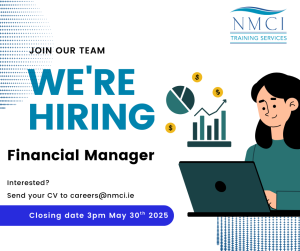
Position: Financial Manager
Reporting to: Managing Director
The successful candidate will be based in the National Maritime College of Ireland.
Closing date for applications: Friday 30th May at 3pm.
Overview of the role
NMCI Training Services (NMCITS), invites applications from suitably qualified persons for a position of Financial Manager based at the National Maritime College of Ireland.
The Financial Manager is responsible for the financial accounts, administration and support of NMCITS. NMCITS is a subsidiary of Munster Technological University (MTU). The Office is an intergral part of the NMCI and deals with the courses providing professional development and training. The role is to ensure that all necessary controls are in place and being implemented and to ensure compliance. It includes responsibilty for supervising and managing staff within the NMCITS team. It is expected the role will liaise closely with the MTU finance department.
Main duties and responsibilities will include but not limited to:
- Account reconciliation
- Treasury
- Tax Reporting & Returns
- Compliance
- Financial Reporting
- Assist in the preparation of the NMCITS Financial Statements and year end files.
- Assist on annual Audits
- Cashflow projections
- Annual budget preparation.
- Supplier related transactions
- Online banking systems
- Payroll
- Annual leave management
- Contracts of employment.
- Any other areas within the financial accounts office as requested or needed.
The successful candidate will have minimum academic qualifications and experience as follows:
Essential:
- Qualification from a recognised accounting body or a relevant third level qualification which encompasses equivalent skills and expertise.
- Proficient working knowledge of Microsoft Office.
- Ability to work effectively on own initiative and in a team environment with commitment to personal and professional development.
- Be well-organised and work to strict deadlines, with the ability to manage and prioritise different, and sometimes conflicting workloads.
- Strong attention to detail and accuracy.
- Ability to maintain data confidentiality of all times.
- Be an effective communicator, with the ability to consult at all levels of the organisation.
- Ability to supervise and mentor staff.
- Experience in preparation of Financial Accounts and associated knowledge and skills.
Desirable:
- A minimum of two years relevant experience.
- Experience in using online software such as Xero/Sage etc.
Terms of the Appointment
- Salary Scale: €43,633.00 – €52,401.00
- Permanent position following a successful probationary period
- Annual leave: 23 days per annum on a pro rata basis.
The Interview Process
If invited to interview, it is likely candidates will be assessed at the interview under the following criteria: Additional criteria may be added for the Interview as the need arises.
- Relevant knowledge and experience
- Leadership Skills
- IT Skills
- Team Working and Organisational Skills
- Communication and Interpersonal Skills
Important Notes
- Screening and short-listing only takes place on the basis of information submitted on the application. In addition to the minimum criteria, it may be necessary to introduce further shortlisting criteria. Candidates should note that they may be called for more than one interview.
- Please ensure that full information is given on qualifications and that the information is accurate and corresponds to the original transcript of qualifications.
- Please ensure that those you nominate as referees are contacted by you and will be able to supply a reference without delay if requested.
- NMCITS regrets that it cannot pay expenses for candidates attending interviews for this post or for taking up the position, if appointed.
- Applications received after the closing date will not be accepted.
- Appointments may be subject to Garda vetting.
Application Process
Applications by email only. Applications will not be accepted in any other format.
Applications to be sent to: careers@nmci.ie
Closing date for receipt of completed applications is 3.00 pm on Friday 30th May 2025.
For an informal discussion, please contact Mr James O’Byrne by e-mail: james.obyrne@mtu.ie
The information given in this document is of a general information nature only and should not be taken as contractual.
NMCITS is an equal opportunities employer.
Sign Up to our Newsletter
Click Here
Posted: March 18, 2025
Calling allsecondary school students in Ireland! Enter the “SEA the Future” Social Media Innovation Challenge during Innovation & Enterprise Month.
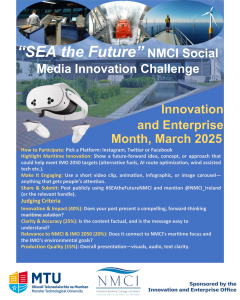
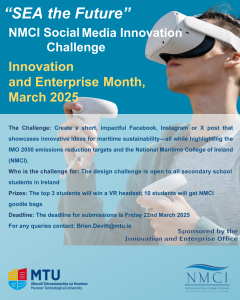
The Challenge: Create a short, impactful Facebook, Instagram or X post that showcases innovative ideas for maritime sustainability—all while highlighting the IMO 2050 emissions reduction targets and the National Maritime College of Ireland (NMCI).
Who is the challenge for: The design challenge is open to all secondary school students in Ireland.
Prizes: The top 3 students will win a VR headset; 10 students will get NMCI goodie bags.
How to Participate: Pick a Platform: Instagram, Twitter or Facebook.
Highlight Maritime Innovation: Show a future-forward idea, concept, or approach that could help meet IMO 2050 targets (alternative fuels, AI route optimization, wind assisted tech etc.).
Make It Engaging: Use a short video clip, animation, infographic, or image carousel—anything that gets people’s attention.
Share & Submit: Post publicly using hashtag #SEAtheFutureNMCI and mention @NMCI_Ireland (X) or @nmcimaritimecollegeireland (Facebook or LinkedIn)
Judging Criteria
Innovation & Impact (40%): Does your post present a compelling, forward-thinking maritime solution?
Clarity & Accuracy (25%): Is the content factual, and is the message easy to understand?
Relevance to NMCI & IMO 2050 (20%): Does it connect to NMCI’s maritime focus and the IMO’s environmental goals?
Production Quality (15%): Overall presentation—visuals, audio, text clarity.
Please share with interested students you know.
Deadline: The deadline for submissions is Friday 22nd March 2025
For any queries contact Brian Devitt. Email: Brian.Devitt@mtu.ie
Good luck!
hashtag #SEAtheFutureNMCI
Sign Up to our Newsletter
Click Here
Posted: February 6, 2025
Project Title: The use of Maritime Autonomous Surface Ships (MASS) in coastal waters and the implications for the future of the maritime industry, particularly from a Maritime Education and Training (MET) perspective.
National Maritime College of Ireland (NMCI)
About the Project
We invite applications for a fully funded 4-year PhD project as a full-time programme of study. This PhD, ‘The use of Maritime Autonomous Surface Ships (MASS) in coastal waters and the implications for the future of the maritime industry, particularly from a Maritime Education and Training (MET) perspective’, is supported by the Marine Institute and funded under the Marine Research Programme by the Government of Ireland.
The project aims to assess and quantify the implications of MASS on the future of Ireland’s maritime industry. The research will identify how MASS will aIect the maritime industry along a range of dimensions that will include, but will not be limited to, operational, technological, safety and human resource implications. The research will address future skills and training needs. By developing the requisite skills and capabilities in Ireland’s maritime industry to take advantage of the expected paradigm shift that MASS will bring about, the competitiveness of Ireland’s maritime industry can be enhanced and new opportunities for job creation identified.
Some of the areas that may be most relevant to focus on include:
- Identify the implications of MASS for Ireland’s maritime industry, and policy
- Develop a methodology to assess how MASS can be operated safely and eIiciently in maritime environments, acknowledging recent advancements in AI for autonomous navigation and machine learning for collision avoidance.
- Assess the implications for MASS on the International Convention of Standards on Training, Certification and Watchkeeping for Seafarers (STCW).
- Identify the training and skills that will be needed in Ireland’s maritime industry to compete and thrive in a competitive global environment in which Maritime Autonomous Surface Ships are commonplace.
- Identify the opportunities that exist for Ireland to develop new skills and capabilities in the changing maritime industry that will enhance competitiveness and support job
- Investigate the link between the research and the need to bring about a digital transformation in Ireland’s maritime industry.
Requirements
Applicants must have achieved at least a second-class higher level (2H1) classification or equivalent in an appropriate discipline area relevant to the research field from a recognised degree awarding body OR possess a Master’s Degree in an appropriate discipline area relevant to the research field from a recognised degree awarding body.
The successful candidate should have a background in the maritime sector, maritime operations or maritime engineering, with strong analytical skills and experience in report writing. Good people and communication skills would be advantageous in this scholarship, given the span of engagement that is involved at national and international level (Government Departments, industry, maritime professionals, personnel from research centres, etc.). They should have an interest in and an aptitude for publishing peer reviewed mixed-methods research and working to improve the awareness of MASS across the maritime sector.
For applicants whose first language is not English, the English language requirements accepted by MTU for entry into postgraduate studies are:
- IELTS Academic 0 (No less than a 5.5 in any one band)
- PTE Academic 51 (Minimum 45 in each component)
- TOEFL IBT 80 min (score of 18 in each component)
- Duolingo score Min of 100
Please refer to – https://www.mtu.ie/international/eu-applicants/
General terms and conditions of this PhD Scholarship award
Start date & location: This PhD starts no later than 11th May 2025. The student will be based primarily at Munster Technological University, NMCI/Bishopstown Campus and will also have access to oIice facilities at the Marine Institute’s Dublin OIice (IMDO Irish Maritime Development OIice). The student will be registered at MTU, working under the supervision of Dr Paul Hegarty (MTU) in association with Dr Breda Kenny (MTU) and Mr Liam Lacey (IMDO), with industry guidance provided by Mr Gordon Meadow.
Funding: The scholarship funding is tax free and includes the payment of University PhD fees (EU or non-EU) and a student stipend at a flat rate of €25,000.00 per annum which is tenable for 4 years.
The scholarship award also includes a budget of up to €3,000 per annum for eligible research costs (travel & subsistence, publication costs, consumables and other costs, such as minor kit purchase e.g. camera) for the sole use of the student and are payable on a reimbursement basis direct to the host institution. There are no overheads payable on the scholarship.
Publication costs are intended to cover publications on which the scholar is listed as first author and are published under Open Access. Scholars can also supplement this funding by applying to the Marine Institute’s Networking & Marine Research Communication Awards annual call. In addition, the cost of a laptop will be covered by the Marine Institute (purchased via the Research Funding OIice).
To apply:
Please send a single PDF File consisting of the following to paul.hegarty@mtu.ie and breda.kenny@mtu.ie with ‘Cullen Scholarship PhD Application’ in the subject heading:
- Resume/Curriculum Vitae (CV), including:
- Education history
- Relevant skills
- Research projects/publications
- A cover letter (2-pages max) including a description of the applicant’s research interests, reasons for applying for the position. The Cover Letter must clearly indicate how the applicant’s profile and skills fit the requirements of this PhD position.
- Scanned copies of relevant academic transcripts and, if applicable, English language certificates.
- A minimum of two recommendation letters and/or contact information for
Further information or queries please email paul.hegarty@mtu.ie and breda.kenny@mtu.ie
Closing date for applications – 25th February 2025 Interviews (online) anticipated to be held early March 2025 PhD commencement date latest by 11th May 2025
Funding Acknowledgement
This project (Grant-Aid Agreement No. CS/24/005 is carried out with the support of the Marine Institute and funded under the Marine Research Programme by the Government of Ireland.


Sign Up to our Newsletter
Click Here
Posted: November 1, 2024
For centuries, Cork has been a safe harbour from storms, rough seas, and pirates. However, in 2024, the concept of a safe harbour has evolved. This was evident on Friday during the
MTU Smart Maritime Cybersecurity Challenge, where the focus shifted to defending Ireland’s harbours and ports against cyber threats. The event featured a cyber attack
simulation on a virtualised maritime port, hosted in MTU’s new Cyber Security Lab and conducted on its state-of-the-art cyber range infrastructure.
The simulation, designed by Airbus, mirrored a real-world cyber attack, paralysing a port’s IT systems and a ship at its entrance, effectively blocking all traffic. Teams from the Irish Naval
Service, National Maritime College, MTU, Cyber Innovate, and WorldSkills Ireland National Champions competed to identify the cyber attack’s entry points, regain control of the vessel,
and assist Europol in arresting the hacker group’s leader.
The Need for Maritime Cybersecurity Skills Irish ports are vital hubs for shipping and maritime operations, making skills in maritime cybersecurity essential to future-proof Ireland’s infrastructure. The simulated cyber attack provided an invaluable opportunity to build real-world, applicable skills to address these growing threats.
MTU Leading the Way in Cybersecurity Training

Photo: Pauline Dennigan
The MTU Smart Maritime Cybersecurity Challenge was held in MTU’s new Cyber Security Lab, which was visited last week by Tánaiste Micheál Martin as part of the Ireland-Wales
Forum 2024. Six teams competed, each featuring MTU staff, researchers, and students.
“Hosting the MTU Smart Maritime Cybersecurity Challenge in our new Cyber Security Lab showcased the strength of our programmes and the exceptional talent emerging from Cork,”
said Dr. Donna O’Shea, Chair of Cybersecurity at Munster Technological University (MTU).
As a leader in cybersecurity education, MTU runs initiatives such as Cyber Skills, Cyber Explore, and the €7M Cyber Innovate project. Cork’s reputation as Ireland’s cyber security
hub is bolstered by MTU’s graduates, a key reason why many national and international companies have established a presence in the region.
MTU also features the Cyber Range, a state-of-the-art platform unique in Ireland, which enables simulated cyber-attacks on virtual organisations. “At MTU, we are dedicated to
advancing cyber security through cutting-edge education and research.” said Dr. George O’Mahony from MTU “This cutting-edge facility provides invaluable training for students,
researchers, and industry professionals, allowing them to build critical skills without risking real-world damage or outages.”
Dr. O’Mahony used the Cyber Range to train and mentor the Irish cybersecurity team that won Gold at the WorldSkills Global Skills Challenge 2024.

Event Highlights
The MTU Smart Maritime Cybersecurity Challenge provided a powerful demonstration of the importance of cybersecurity in Ireland’s maritime sector.
Prize Winner Details
The winning team comprised a mixture of Naval service, MTU student, NMCI staff and Cyber Innovate scholars.
Stephanie Wallace Chavanne, Harry Dunne, Oskar Wolak, George O’Mahony, Tim McSweeney, Wiktor Owczarek and David Dennehy
The Maritime Challenge is part of an event in the lead up to the Smart Maritime & Offshore Wind Event on the 11th of November at the National Maritime College of Ireland in Cork.
The event will start at 9:30am. https://www.cyberskills.ie/explore/events/join-us-at-thesmart-maritime–offshore-wind-event-on-the-11th-ofnovember.html

Contact Details:
Catherine Wilson is the media contact for this press release
Mobile: +353 87 693 2561
Email: Catherine.Wilson@MTU.ie
Photographs with captions are located here:
Photographer: Barry O’Sullivan
https://drive.google.com/drive/folders/1LDFFx-6sAif_Ou-xPzvMenWZr3iYeAk2
News coverage on gold medal win
https://www.mtu.ie/news/worldskills-global-skills-challenge-2024/
Sign Up to our Newsletter
Click Here
Posted: October 18, 2024
PRESS RELEASE
Friday, 4th October 2024
National Maritime College of Ireland marks 20th anniversary

Paul Hegarty, Head of NMCI, Tánaiste Micheál Martin, President of MTU Maggie Cusack and Minister for Further and Higher Education, Research, Innovation and Science of Ireland Patrick O’Donovan TD looking at a model of the MV Arklow while attending a special event to mark the 20th anniversary of the National Maritime College of Ireland (NMCI). Photo Credit: Darragh Kane
The National Maritime College of Ireland (NMCI), one of Munster Technological University’s (MTU) six campuses and a strategic partnership between MTU and the Irish Naval Service, marks its 20th anniversary today (04.10.2024) with a special event at its campus in Ringaskiddy in Cork.
The NMCI provides maritime education and training to meet the current and future needs of the State across the maritime sector, offering a range of undergraduate and postgraduate degree programmes in Nautical Science, Marine Engineering, Marine Electrical Engineering, Supply Chain Management and Maritime Operations. The NMCI is a purpose-built facility with advanced bridge and engine room simulators, including specialist facilities such as an environmental pool, fire training unit, technical workshops and operational engine room. The NMCI is also the only recognised training centre for the RNLI in Ireland.
Today’s anniversary event was attended by An Tánaiste, Micheál Martin T.D., and Minister for Further and Higher Education, Research, Innovation and Science Patrick O’Donovan, T.D.
Addressing the celebration, An Tánaiste Micheál Martin T.D., said: “I’m delighted to attend today’s 20th anniversary celebrations given that, as Minister for Education, I was involved in the process that led to the NMCI’s establishment. It was a major investment in maritime education at that time and I’m pleased to see that it’s gone from strength to strength over that 20 years.
The multi-million euro investment in the simulator suite further demonstrates our commitment to the NMCI. This institution has been, and continues to be, a critical asset in maintaining our Defence Forces’ readiness and operational effectiveness. To date, 13,500 Naval Service personnel have attended the college, developing their skills and gaining invaluable qualifications.”
Minister for Further and Higher Education, Research, Innovation and Science Patrick O’Donovan T.D. said: “I am delighted to be part of this milestone event that marks the 20th Anniversary of the National Maritime College of Ireland. The NMCI has provided Maritime Education and Training to meet the national need, having trained over 80,000 students. I am looking forward to at least another 20 years of the NMCI delivering for the maritime workforce of this island nation.”
Also speaking at the 20th anniversary event today was Dr Paul Hegarty, Head of the NMCI, who said: “The National Maritime College of Ireland has gone from strength to strength since we were founded 20 years ago. As an island nation, the maritime industry is key to facilitating economic growth and prosperity. Connecting us with our trading partners, it is a vital industry that is experiencing annual growth, with vast professional opportunities open to our students once they graduate. Our graduates are employed globally, working in a variety of roles including officers and seafarers in the transit and supply chain industry, renewable energy and oil and gas industries, amongst others.

Dr. Paul Hegarty, Head of NMCI speaking at a special event to mark the 20th anniversary of the National Maritime College of Ireland (NMCI) Photo Darragh Kane
“Harnessing renewable energy such as offshore wind energy projects is a key Government climate target, and one that requires a skilled maritime workforce. As we move into our next decade, NMCI will play a key role in helping Ireland meet its future energy demands, and we are ready to embrace future challenges and create new opportunities.
“Similarly, we look forward to continuing our strong tradition of delivering core maritime education and training while evolving to reflect the technological and digital transition occurring across the maritime sector. Having an agile maritime sector will be a strategic enabler for the future national economy.”
Speaking at the launch, President of MTU, Professor Maggie Cusack said: “NMCI’s commitment to excellence, innovation, and collaboration over the past two decades has been integral to Ireland’s maritime industry and has positioned it at the forefront of international maritime education. NMCI’s success is a testament to the vision, dedication, and collaboration of all those involved.
“As we mark this important milestone, we look forward to continuing our strong partnership with industry and government, ensuring that NMCI remains a hub for cutting-edge maritime research and development, and that our graduates are well-equipped to lead in this critical sector. Together, we will reimagine the vision set out for the NMCI, enhancing a national institution that will enable Ireland’s maritime future.”
Jimmy Deenihan, Chairperson of MTU’s Governing Body said: “We are immensely proud to celebrate the 20th anniversary of the National Maritime College of Ireland, a pioneering institution that has become a global leader in maritime education and training. As Chair of the Governing Body, I am confident that NMCI will continue to thrive and expand its influence, contributing significantly to the future of the maritime industry and the broader economy. We look forward to supporting its continued growth and impact for many more years to come.”
At the celebratory event organisations such as the Irish Coast Guard and the Irish Naval Service welcomed guests by showcasing their lifeboats at the NMCI.

Photo: Darragh Kane
Further information about the NMCI is available here: https://www.nmci.ie/
ENDS
Contact: Niall Cowley, We The People, email: mtu-pr@wtp.ie; 083-8354976
About the NMCI
The NMCI is a purpose-built College on a 10-acre campus and is located 18km from Cork city in Ringaskiddy. It provides training and education for the Merchant Shipping Industry, and the non-military needs of the Irish Naval Service. The NMCI provides education and training services of the highest quality and includes degree programmes in Nautical Science, Marine Engineering, Marine Electrotechnology, and Supply Chain & Logistics. Specialist spaces including survival facilities, seamanship workshop, fire-fighting/damage control, jetty and lifeboat facilities and ship engine room are provided. The College also provides modern simulation equipment in the areas of navigation, bridge training, communications, engineering machinery operations, liquid cargo handling/damage control and vessel traffic systems.
About MTU
Munster Technological University is the southwest’s newest technological university consisting of six campuses across Cork and Kerry. The University has a student body of 18,000. It is a leader in higher education both regionally and internationally through the provision of a wide range of programmes ranging from apprenticeships and undergraduate degrees to Master’s and PhDs.
Sign Up to our Newsletter
Click Here

 reply
reply retweet
 favorite
Connect with NMCIS