Posted: August 4, 2015

At SEFtec NMCI Offshore (SNO) we believe in rewarding our customers and giving back to the Oil & Gas Community. As a result we have decided to reward you, our customer. We are now offering a 50% discount on all of our OPITO approved Offshore Courses taking place during September 2015 & October 2015. Think of it as our way of thanking you for choosing SNO for your offshore training needs.
Wondering if you need training? Check out the list below of all the courses which we will be running during September & October 2015. All you have to do is click on the links which will bring you directly to the course booking. When booking our system will automatically take 50% off the cost of each course for you so there’s no need to enter a code when booking. Simple.
BOSIET Course running September 7th & October 12th – Book your place here
FOET Course running September 24th & October 1st – Book your place here
MIST Course running September 10th & October 15th – Book your place here
CA-EBS Course running September 9th, September 24th, October 1st & October 14th – Book your place here
(TEMPSC) Further Offshore Lifeboat Coxswain Training – Refresher running September 14th – Book your place here
Remember that a FOET is a refresher of your BOSIET.
Sign Up to our Newsletter
Click Here
Posted: July 23, 2015
The key to maintaining a safe shipping environment and keeping our oceans clean lies in all seafarers across the world observing high standards of competence and professionalism in the duties they perform on-board. The international Convention on Standards of Training, Certification and Watch keeping for Seafarers 1978, as amended in 1995 and again in 2010, sets those standards, governs the award of certificates and controls watch keeping arrangements . Its provisions not only apply to seafarers, but also to ship-owners, training establishments and national maritime administrations.
New Legislative Requirements
In conforming to the provisions of STCW Convention Regulation 1/14, and section A-1/14, of the STCW Code, companies must ensure that seafarers assigned to any of their ships have received refresher and updating training as required by the convention.
If a member of your team is serving on board a ship and is qualified in any of the following, they must, as of the 1st of January 2017, have documentary evidence of either having completed the training course or updated their training within the last 5 years.
The 2010 Manila Amendments to the STCW Code introduced new requirements for seafarers to hold the following certificates of proficiency:
- Personal Survival Techniques (STCW Table A-VI/1-1)
- Fire Prevention and Fire Fighting (STCW Table A-VI/1-2)
- Proficiency in Survival Craft and Rescue Boats Other Than Fast Rescue Boats (STCW Table A-VI/2-1)
- Proficiency in Fast Rescue Boats (STCW Table A-VI/2-2)
- Advanced Fire Fighting (STCW Table A-VI/3)
Seafarers required to hold any of the certificates of proficiency listed above shall, every five years, provide evidence of having maintained the required standard of competence to undertake the tasks, duties and responsibilities.
Seafarers validating their CoC or CoP after 1st January 2017 will be required to submit documentary evidence of having completed such training.
Deadlines to meet
The 2010-amended STCW Convention came into force on 1 January 2012. However, there is a five year transitional period, until 1 January 2017, to allow for a phased in implementation of the provisions. After January 2017, all seafarers are required to meet STCW 2010 standards. The three important dates to remember are:
1 January 2012
The STCW Convention comes into force for all countries party to the convention. From 1 January 2012 onwards, requirements for the new minimum rest hours and a record of hours of work must be complied with. For a period of five years, until 1 February 2017, on a national basis the different revised regulations contained in the 2010-amended convention will be phased in. During this five year transitional period, a party may continue to issue certificates of competency in accordance with its previous practices, however from 1 July 2013 new seafarers-training and competence should comply with the 2010-amended STCW Convention.
1 January 2014
After 1 January 2014 seafarers will have to be trained in security in compliance with the new provisions.
1 January 2017
The implementation period ends. From February 2017 onwards all seafarers on active service must comply with all the 2010-amended STCW requirements and be in possession of a valid STCW certificate covering the functions performed on-board. Administrations will also issue and recognise and endorse certificates in accordance with the STCW provisions prior to 2010 for those commencing training prior to 1 July 2013.
Basic safety training for officers:
Officers serving on any type of ship who are designated with safety and pollution prevention responsibilities in the operation of the ship need basic safety training. Such training must cover personal survival techniques, basic fire prevention and fire fighting, elementary first aid, and personal and social responsibilities. This requirement applies to practically all officers serving on merchant ships. Cadets assigned with these duties also need to complete basic safety training before going to sea. Basic safety training should be documented as having taken place within five years of the officers being assigned to safety and pollution prevention duties. You need to complete an approved training course or provide evidence that you have achieved the required standards of competence within the previous five years (by participating in drills and exercises, for example, or assessment by a qualified assessor). It is advisable that you do hold some form of documentary evidence to show that you have achieved competence in these functions within the previous five years (this may be in the form of record of drills or letters from a training centre).
New requirements of the amended 2010 STCW
All ships must have a qualified security officer delegated by the company and master of the ship, who is responsible for ensuring that the other crew are familiarised and trained in security matters for that vessel. The revised convention has introduced bridge resource management and engine resource management requirements for senior officers and leadership and management skills within their certificate. Companies should be responsible for providing training in these areas where seafarers do not have appropriate training. Where the company requires to carry an electro-technical officer they should comply with the new competency requirements under A-III/6.
General requirements for ratings
Ratings fall under three general categories; those forming part of a watch (deck or engine), those who are not assigned watch-keeping duties, and those undergoing training. As a rating you are required to meet minimum standards of medical fitness, minimum age (if designated with watch-keeping duties), competence (if designated with watch-keeping duties), and seagoing service time (if designated with watch keeping duties). Ratings who are not assigned watch-keeping duties or those still undergoing training are not required to hold watch-keeping certificates. All other certification requirements for ratings depend on the functions performed on board.
Ratings assigned watch-keeping duties
Ratings forming part of a watch (deck or engine) need to be specifically certified for this function. If you are part of a navigational watch, you need to hold a certificate known as ‘rating forming part of a navigational watch’ certificate. On the other hand, if you are part of an engineering watch, you will need to hold a certificate known as ‘rating forming part of an engineering watch’ certificate. To obtain these certificates you need to show that you are competent in the functions. You can find the complete version of these in the STCW Convention under section A-II/4 for deck personnel and A-III/4 for engine personnel. Seafarers who have the appropriate competencies to become able seafarer deck or able seafarer engine under the new provisions II/5 and III/5 must first have become proficient watch keepers. However if you served for a period of not less than one year as a rating in the relevant capacity before the convention came into force for the administration issuing your certificate then you may be considered to meet the competence requirements and will be certified accordingly, without needing to undergo any further training. The above may also apply to integrated ratings under the new provisions of VII/2.4.
Ratings forming part of a navigational watch
You should meet the competence requirements stated below. These do not apply to ratings on ships of below 500 gross tonnages. You must be able to:
1. Steer the ship and comply with helm orders issued in English (covers the use of magnetic and gyro compasses, helm orders, change over from automatic pilot to hand steering device and vice-versa).
2. Keep a proper look-out by sight and hearing (covers the responsibilities of a look-out including reporting the approximate bearing of a sound signal, light or other object in degrees or points).
3. Contribute to monitoring and controlling a safe watch (covers shipboard terms and definitions, use of internal communication and alarm systems, have the ability to understand orders and to communicate with the officer of the watch in matters relevant to watch-keeping duties, be familiar with the procedures for the relief, maintenance and hand-over of a watch, the information required to maintain a safe watch and basic environmental protection procedures).
4. Operate emergency equipment and apply emergency procedures (covers knowledge of emergency duties and alarm signals, knowledge of pyrotechnic distress signals, satellite EPIRB’s and SARTS, avoidance of false distress alerts and action to be taken in the event of accidental activation).
Ratings forming part of engineering watch
If you are part of an engineering watch you should meet the competence requirements stated below. The requirements are the same as for STCW-95. They do not apply to ratings on ships of below 750kW in propulsion power.
You need to be able to:
1. Carry out a watch routine appropriate to the duties of a rating forming part of an engine room watch, and communicate effectively in matters related to watch-keeping duties (covers terms used in machinery spaces and the names of machinery and equipment, engine-room watch-keeping procedures, safe working practices in engine-room operations, basic environmental protection procedures, use of internal communications systems, engine room alarm systems, and ability to distinguish between the various alarms with special reference to fire extinguishing gas alarms).
2. Keep a boiler watch and maintain the correct water level and steam pressure (covers safe operation of boilers).
3. Operate emergency equipment and apply emergency procedures (covers knowledge of emergency duties, escape routes from machinery spaces, familiarity with the location and the use of fire fighting equipment in machinery areas).
Ratings’ duties on joining any ship
All ratings need to complete a period of ship-specific familiarisation training, including security before being assigned any shipboard functions. There is no certificate awarded for this, but a record should be kept of it in the ship’s official logbook. This requirement applies to any member of the crew, including hotel staff in passenger ships.
Basic safety training for ratings
Ratings serving on any type of ship who are designated with safety, security and pollution prevention responsibilities in the operation of the ship need basic safety training. This covers personal survival techniques, basic fire prevention and fire fighting, elementary first aid, and personal and social responsibilities. This requirement applies to practically all ratings serving on merchant ships as well as to ratings undergoing training. Basic safety training should be documented as having taken place within five years of a rating’s being assigned to safety and pollution prevention duties.
You need to complete an approved training course or provide evidence that you have attained the required standards of competence within the previous five years (by participating in drills and exercises, for example, or assessment by a qualified assessor). There is no requirement for seafarers to hold an official certificate of basic training, but it is advisable that you possess some form of documentary evidence to show that you have attained competence in these functions within the previous five years (record of drills or letters from a training centre).
Click here ( STCW Guide ) to view the full guide produced by the IMO.
Sign Up to our Newsletter
Click Here
Posted: June 8, 2015
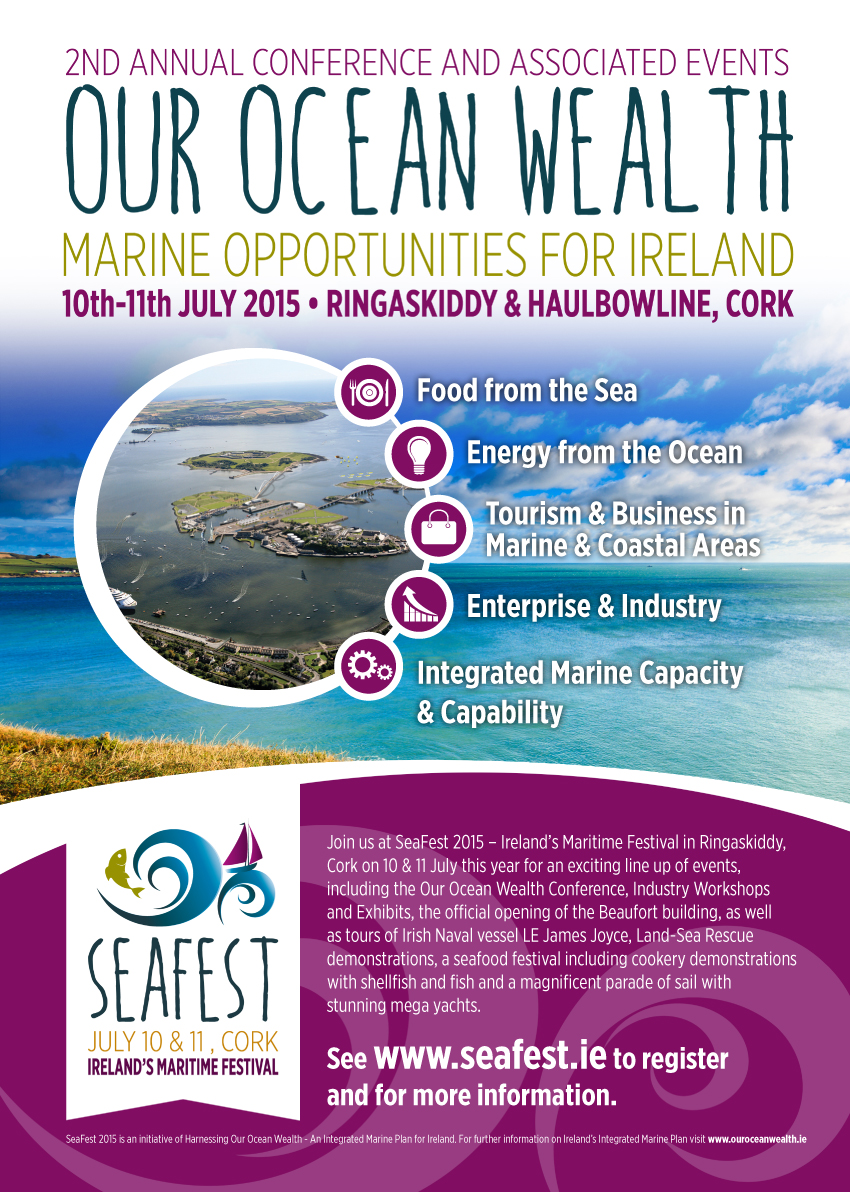
A major celebration of Ireland’s ocean wealth will take place this summer in the real capital of Ireland, Cork, the rebel city. A two day event, 10th and 11th of July, is planned for Ringaskiddy and Haulbowline in association with The Marine Institute, IMERC , the Beaufort Building, the National Maritime College of Ireland, NMCI Services and the Irish Naval Service.
The event is an initiative of Ireland’s Integrated Marine Plan – Harnessing Our Ocean Wealth. It will build on the first annual “Our Ocean Wealth Conference” which took place in Dublin Castle last July. The event was attended by over 500 delegates. This year the organisers hope to attract a wider audience over the two day event which will include a conference, marine technology expo, investor events, workshops, a seafood festival, family fun, and competitions.
By broadening its scope to include a range of activities open to families as well as businesses and potential investors, the event aims to highlight the social, cultural and economic benefits of Ireland’s marine sector and provide a platform for public engagement with Ireland’s marine resource. With trade fairs, an Oceanic Experience, Mega Yachts and tours of Haulbowline, NMCI & the Beaufort building it’s definitely a date for the diary.
So, why not save the dates? July 10th and 11th 2015…. It’s your chance to visit us here at NMCI Services and gain an insight into the maritime sector.
For further information regarding this spectacular event keep an eye out on the NMCI Services blog over here where we will keep you updated on developments or why not check out the official conference website here.
Remember to use the hashtag “#SeaFest” on twitter and to follow them over here; https://twitter.com/Seafest_ie
Sign Up to our Newsletter
Click Here
Posted: May 20, 2015
The summer of 2015 is one of great importance for the Port of Cork. With several Cruise Ships set to dock in our harbour, whether it be at the deep water berth in Ringaskiddy or at the dedicated cruise berth in Cobh, it looks like this summer will see Cork become the tourist destination of choice for many cruise passengers. Most recently the MSC Splendida stopped in the dedicated cruise berth in Cobh on Tuesday May 12th.
Before entering Dublin Port, which has 300m operational limit on ship length, MSC Splendida’s captain flew from Italy to Cork to practice the navigation on our high-tech bridge simulator at the National Maritime College of Ireland. The MSC Splendida had previously cruised into the history books with the arrival of the 333m long MSC Splendida cruise liner, the longest ship to ever call at Dublin Port.
She is one of 83 cruise calls confirmed for Dublin Port this year, which will see a total of 140,000 passengers arriving to sample the sights of Dublin. The MSC Cruises ship built in 2009 has 4,600 passengers and crew that were greeted by a Celtic-inspired welcome on the quayside. This featured a live ceili band, Irish drummers, dancers and entertainment before passengers departed for the city’s shops and attractions.
We can’t just let Dublin have all the credit though, Port of Cork is set to welcome a staggering 43 cruise ships by the end of October. Cruise companies are acknowledging the value of Port of Cork and what Cork has to offer its passengers.
With the proposed future development plans for the Port of Cork we are sure to see this figure increase in the coming years. For the full schedule why not check out the Port of Cork website here.
Sign Up to our Newsletter
Click Here
Posted: May 12, 2015
Union asks UK government to lead new efforts to cut “appalling” death toll
Nautilus International is calling for the UK to lead a new and concerted drive to end the appalling litany of seafarer fatalities in enclosed spaces. You may remember we did a blog on this a few weeks ago. It can be found by clicking here.
The Union has written to shipping minister |John Hayes following an incident in which two seafarers died in a cargo hold of the Carisbrooke shipping general cargo vessel Sally Ann C in March.
Investigations into the incident – which took place off the coast of West Africa- are underway, but it is known that the chief office and chief engineer died after entering a hold where timber was stowed and the second officer had to be rescued after losing consciousness when he went to the aid of his colleagues.
In a letter to the minister, Nautilus general secretary Mark Dickinson said the case followed a ‘very familiar pattern of one crew member collapsing in an oxygen deficient area, and two more being overcome after entering the space without personal protection equipment in an attempt to rescue their colleagues’.
Mr Dickson said there is evidence to show that more seafarers die or are injured in enclosed spaces than through any other on board work activity.
‘Changes in ship design and operation, the nature of cargoes, the increasing amounts of chemicals being carried, along with reduced manning levels and radical changes in crewing practices are all factors which have driven the increase in such accidents’ he added.
He warned the minister that simply continuing to warn seafarers of the dangers is not sufficient, and he urged the UK to lead European and international efforts to develop fresh approaches to the issue.
Nautilus says mandatory training requirements are needed and IMO rules should ensure that all ships are equipped with oxygen to ensure crew can test the atmosphere in enclosed spaces.
‘Better consideration should be given during the design and build stages to address some of the inherent risks – and the arrangements for rescue in particular’ Mr Dickson added. ‘We believe that requirements for oxygen meters to be positioned at the entrance to enclosed spaces would reinforce to seafarers the potential risks that they face, as well as providing ready access to information about the state of such spaces’.
The Union is also calling for improvements to secure a much better standard of risk assessments – moving away from a generic assessment to one that addresses particular hazards or design features associated with each individual enclosed space.
‘The tragic accidents in the enclosed spaces have resulted in a spate of investigation reports and resulting recommendations, as well as a steady flow of material to reinforce the precautions that should be taken’ Mr Dickinson told the minister. ‘However, the continued death toll should surely tell us that something is wrong with this approach. I hope you can support our aim to deliver innovative thinking to address the situation and to find improved ways of tackling some of the fundamental problems. We really cannot afford to continue witnessing the shocking scale of fatalities that blight the industry’.
Three dock workers died in the Belgian port of Antwerp last month after entering the hold of a Hong Kong flagged general cargo ship to unload coal.
International Transport Workers’ Federation president Paddy Crumlin commented “Antwerp is a port where health and safety is taken very seriously, and, like the three men’s trade unions, we are confident that a full investigation will take place into what happened and how any resulting lessons can be implemented”.
Sign Up to our Newsletter
Click Here

Connect with NMCIS