Posted: November 15, 2012
We’ll be tuning into Ireland’s Search and Rescue on RTE 1 this Sunday at 6.30pm to see a few familiar faces.
Following on from the success of the two Irish Coast Guard helicopter rescue series, Rescue 115 and Rescue 117, Ireland’s Search and Rescue is a six part series, presented by Claire Byrne. This new series features the Irish Coast Guard helicopter bases in Dublin, Waterford, Shannon and Sligo as well as RNLI stations and Mountain Rescue teams nationwide. The series also shows the work of Cork City Fire Brigade and volunteer Coast Guard groups.
(Image property of RTE)
See http://www.rte.ie/tv/programmes/searchandrescue.html for further information.
We wish all involved the best of luck with the new series.
Sign Up to our Newsletter
Click Here
Posted: February 27, 2012
In the latest edition of Dry Cargo International magazine, GAC’s ship agency operations are discussed as well as GTSS, the NMCI and the partnership with Brobulk. Read the full article below:
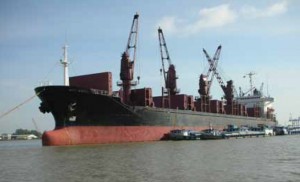
Ships’ agents prove their worth
GAC is a global provider of shipping, logistics and marine simulation training. As one of the world’s largest ship agencies, it has developed its business on a reputation for professionalism and quality service. As ships’ agent, GAC represents more than 3,500 customers and handles close to 60,000 vessels annually through a worldwide network of over 300 offices and a presence in over 40 countries. It is due to the breadth of services that it can offer worldwide that the GAC Group has the financial strength, experience and economies of scale to offer a one-stop solution to customers across the globe. In this article, GAC’s group sales director of shipping, Neil Godfrey, gives his insights into the company’s role in the ships’ agents market, and a view of the shipping industry in general.
As a ships’ agent, GAC offers an extensive portfolio of services related to both ship and cargo, which can be tailored to
meet each customer’s needs. These include: read more…
Sign Up to our Newsletter
Click Here
Posted: December 15, 2011
The final article for the Port Strategy was released recently. Read the full article below:
“Yes, you can do a Marine Risk Assessment, even quite a sophisticated one, which doesn’t go into sufficient detail or misses the point entirely says Captain Stephen Gyi of GAC Training and Service Solutions.
Unfortunately, this ‘missing the point’ can be less an oversight and more of a “commercially driven decision”, he adds.
Outlining a basic process, he explains that a group of experts identify the probable marine related hazards (HAZID) and resulting environmentally related hazards (ENVID), including emergencies such as vessels losing power, colliding or running aground. Obviously, “those risks with potential to endanger life or damage the environment are particularly important to capture”.
The levels of consequence and the likelihood of occurrence are filled out, often on a five-by-five risk matrix. From this the team returns to the beginning and assesses each hazard in turn, which provides a value of either high, medium or low risk, depending on the chosen values for that location, type of cargo and vessel involved, and the scenarios are re-run with projected mitigation measures in place. While there are almost always measures that can be adopted, they usually come with a cost attached, so the idea is get all associated risks down to what industry recognises as ‘as low as reasonably practical’ or ALARP. read more…
Sign Up to our Newsletter
Click Here
Posted: October 18, 2011
“Training too often seen as a ‘soft’ cost.’ The lastest article from Jeffrey Blum highlights the importance of training. Offshore training in particular is something we focus on here at the NMCI.
“The struggling dry bulk sector suffers from a basic lack of professional expertise that can generate serious problems. The cause and solution are straightforward, argues Jeffrey Blum.
Perhaps the most striking difference between the dry bulk sector today and a decade ago is the increasing dominance of the market by large companies.
In itself, this is not a problem but the industry has been navigating tough times for a number of years and, as a result, training is often high on the list of immediate cost cutting opportunities. This is short sighted.
The size of a company does not necessarily dictate a level of professionalism, expertise or commitment to quality training within it. Because of their size and scale, too many believe they can rely upon internal expertise to train others – an approach that is more often than not ineffective.To avoid the mistakes of one generation being passed down to the next, these organisations need more thorough and standardised training than current internal processes provide. The sector is already struggling with self professed experts disseminating their ‘knowledge’ and, by doing so, simply extending their own operational ineffeciencies.
The proof of these problems lands on arbitrators’ desks every day. Of the disputes I come across, too many stem from a basic lack of knowledge and understanding.
Commonly these disputes are about demurrage calculations, but the subject of the dispute is secondary to its underlying cause: a lack of training in how to carry out these processes appropriately. read more…
Sign Up to our Newsletter
Click Here
Posted: August 23, 2011
 Suppliers deliver new systems to colleges, academies and ship operators as guidelines on ship-to-ship transfers and vessel handling are set to increase demand for innovative bridge simulators
Colleges with 360 degree simulators are the main beneficiaries when ship managers follow guidance on training for vessel handling and ship-to-ship transfers (STS). The guidance regarding STS training comes from the UK’s Maritime and Coastguard Agency (MCA), which has called for practical courses to help mitigate the safety and environmental risks arising from these operations.
Training centres have invested heavily in new simulators from suppliers including Kongsberg Maritime, Transas and Ari Simulators in response to the rising demand for training on modern bridge equipment. The National Maritime College of Ireland (NMCI) in Cork claims to have the world’s largest bridge simulator suite, supplied by Kongsberg Maritime and utilised by GAC Training and Service Solutions (GTSS) for its STS courses.
According to Clive Hotham, who lectures for GTSS on its simulator-based STS operations course, training requirements for these activities will become mandatory in the future.
“Any situation in which ships are in close proximity to each other or moving at speed poses very real dangers, including vessel damage, injuries to the crew and environmental implications,” he says. “This makes ship-handling experience critical, especially in delicate operations such as mooring or STS. At the moment, specialist training for STS professionals is voluntary. But the MCA has started issuing guidance on the subject and it never seems long before guidance becomes law. I have no doubt that it will become mandatory that the master, at least, has been on some sort of training course.”
There are advantages with using 360 degree screens as they add a high level of reality to the training. “Simulator training enables a progression of challenging scenarios and such a flexible and varied range of conditions that we can clearly see if our trainees are operating in a safe manner,” explains Mr Hotham. “It also allows us to train them to recognise when they should make the decision to abort the operation because of poor weather or other problems.
“Once an exercise has begun, participants tend to forget it’s a simulation. This is particularly useful when we throw things at them that we hope would never happen, like engine breakdown or steering failure. They experience the full stress of the situation in a safe environment, allowing us to train them to react appropriately.”
NMCI’s simulator also has the capacity to link two bridges together, as in real world ship-handling scenarios. “We have eight or nine ships in our electronic tanker fleet, and with just a phone call we can obtain more from Kongsberg Maritime’s database,” adds Mr Hotham. “For clients running a lot of courses it’s even possible to train in simulations of their own real-world ships. In a simulator you can change the time, weather and seasons as you wish – summer to winter, day to night, sunny to thundery.”
In another deal, Kongsberg Maritime will supply eight Polaris ship’s bridge simulators to academy Vlaamse Dienst Voor Arbeidsbemiddeling en Beroepsopleiding (VDAB) in Zeebrugge, Belgium. The VDAB facilities will help train crew for local shipowners, including two of the world’s major dredging companies, Jan De Nul and DEME.
The Polaris simulators will allow students to train in a large number of sailing areas and over a broad range of disciplines including navigation, manoeuvring and ship handling, plus search and rescue operations. Starting in August, Kongsberg is due to deliver two Polaris DNV B bridges with 225 degree visual systems and six Polaris special task stations, each equipped with a 30 degree visual system. The installation will also include an instructor station and a secondary instructor or debriefing station.
Kongsberg Maritime recently helped shipowner Ezra Holdings open a suite of simulators in the EMAS Academy, the first of their kind in Singapore. The new facility includes a full-mission offshore vessel simulator with fore and aft bridges and a Kongsberg K-Poss dynamic positioning simulator. There are also two anchor handling simulators and one for training engineroom personnel.
Transas Marine will be delivering a full mission simulator to Kimberley TAFE Broome Maritime in Western Australia. The simulator will be used to train pilots and tug masters, who will operate in a new port development. The centre’s range of services will be expanded further through a research project. For this, Transas will develop rotor tug ship models and will integrate real drop-in panel and steering controls from Schottel for advanced training of masters and integration with pilots in live situations. The Transas simulator will have a number of replaceable panels including a set of controls for anchor handling vessel manoeuvring and all associated offshore training. The facility will have a configurable design for the main bridge console, so trainees will be able to use real steering controls from Sperry Marine and Raytheon Anschütz integrated bridges.
The system is based on a Navi-Trainer Professional 5000 ship handling simulator. The visualisation system will have the highest level of realism, featuring wind-generated sea state and variable swell models. There will be accurate vessel and wave interaction, full scene and environment reflection, and three dimensional bow waves and propeller wash. New grounding, synchronous rolling, broaching and other modelling features will be included.
Ari Simulation has supplied simulators for Indian shipowner Great Offshore for offshore vessel and crane handling. The facility can recreate the bridges found on anchor handlers and platform supply vessels operated by Great Offshore. It can be integrated with Poscon controls and dynamic positioning. Great Offshore will use the training centre to simulate ship handling, crane operations, heavy lifting, towing and navigation. The main simulator has nine plasma displays providing a 270 degree field of view. The aft bridge simulator has ship handling and engineering controls.
German company Safebridge has signed an agreement with Sperry Marine to provide online training for users of its VisionMaster FT ship navigation systems. Safebridge’s software allows students to train on all the watch modes found on the Sperry Marine bridge products supplied to the vessels they work on. It enables seafarers to access hands-on training at any time, so long as they have internet access. Users are taken step by step through a number of modules, replicating the use of the actual equipment, and are shown how to use each feature in various simulated scenarios.
To sign up to our newsletter click here – http://www.nmci.ie/newsletter-signup
Sign Up to our Newsletter
Click Here


Connect with NMCIS